
Dual-Wall Stack Design
A dual-wall stack consists of an outer shell and an inner cylinder separated by an annular air gap. The inner cylinder is commonly called a liner, and that term is used throughout this article. The liner is often constructed of more corrosion-resistant material. While some designs contain multiple internal flues, this article focuses on the typical case of one liner supported by the outer stack. The outer cylinder is sometimes called a windshield; here we refer to it simply as the stack.

Analysis Challenges:
The analysis of the stack with a liner appears simple on the surface, but it can become very complicated. The liner is provided support from the stack through guides which provide lateral support but do not restrict any vertical movement due to differential thermal expansion. These guides may have gaps which need to be considered, meaning that the liner receives no support until the relative displacement between the liner and stack exceeds the gap distance.
Some stack/chimney codes recommend that no stiffness of the liner be considered in the analysis, but the stresses imposed on the liner are to be considered. The intent is to not rely on the liner stiffness in the analysis in order to be conservative, so in effect the liner is just along for the ride. The standards don't really explain how to perform the dynamic analysis when the liner stiffness is to be disregarded. Do you consider both stack and liner together or acting independently? There are different ways to handle this situation and this article will attempt to explain the approach we have taken in MecaStack, using an actual example to illustrate.
Cases to be Considered:
We will now consider four different variations of the stack, to show the different analysis methods that are possible when there is a dual-wall stack. Here are the four (4) different scenarios we will consider for a specific stack with liner.
In cases 1a and 1b we will consider that the liner Stiffness is contributing to the overall stiffness of the system. In cases 2a and 2b the liner stiffness will NOT contribute to the overall lateral stiffness of the system. In cases 1a and 2a the guides connecting the outer stack to the liner will be assumed to be linear, meaning that there are no gaps and the stack and liner lateral deflections will be identical at the liner guide locations. In cases 1b and 2b there will be gaps considered, so that the relative displacement between the stack and liner must exceed the amount of the gap before the guide starts providing lateral support to the liner. The four (4) cases are summarized in the table below.

All of the supporting MecaStack input files, Staad.Pro input files and calculations can be downloaded by clicking this link.
Example:
All four (4) examples will use a stack that is 50 m tall, with an outer diameter of 3 m and a thickness of 8 mm. The liner will be 50 m tall also, and its outer diameter will be 2.8 m with a thickness of 3 mm. The liner is supported by the main stack at an elevation of 1 m above grade. The liner is guided by the outer riser at elevations of 50 m, 33.33 m and 16.67 m.
To keep the problem simple, we will not consider any attachments on the structure (Ladders, platforms, piping, etc.). The wind load will be a simple 1.7 kPa over the entire height of the stack with a shape factor of 0.7. The seismic will also be taken as a simple 0.1g lateral load acting on the entire stack.

Staad.Pro Modelling:
Our goal is to validate that MecaStack is calculating the forces, moments and deflections accurately. In order to do this we need to use a proven 3rd party tool to perform an independent calculation. We chose to use Staad.Pro, which is a commercial structural analysis software package that is widely used and accepted throughout industry.
Using Staad.Pro software we construct a model of the stack with the liner. The stack is modelled as a beam with the properties of that for a cylinder with the diameter and thickness of the stack. Similarly, the liner is modelled with beams using the properties of a cylinder. Now the problem becomes that the beam elements for the stack and liner are on top of each other since the stack and liner cylinders are concentric. We cannot create connector elements between the stack and liner, because it would result in a zero-length member. The way we approximate this situation is that we create a very small offset of the liner in the x direction, in this example we used an offset of 0.3 mm. Two models were constructed, one for the dynamic analysis and the other for the lateral loads (Wind and Seismic).
Staad.Pro will be used to calculate the member end forces, deflections and support reactions. In the case of stacks, we usually follow specialized buckling criteria for cylinders, and Staad.Pro does not contain the codes typically used for stacks/chimneys. Those equations are already used heavily in MecaStack and have been thoroughly vetted, and so in this validation we are only interested in verifying member end forces, deflections and support reactions.
Dynamic Analysis:
When we are to ignore the liner stiffness then how do we handle the dynamic analysis? We are going to bracket the problem and find the two extreme cases. Gaps are nonlinear and the modal analysis is performed on a linearized state and so we assume all guides are engaged.
First, we ignore the liner and solve for the dynamic behavior of just the outer stack, ignoring any liner mass contribution. Second, we include the stiffness of the liner so that we analyze the stack and liner together and then perform the dynamic analysis. This gives us the two extremes and ensures that we bracket the solution and find the worst case.
Validation Results: Dynamic

Case 1a: Liner Stiffness Included
Both the main stack and liner are modelled together, and the stiffness of both the outer stack and inner liner are working together to resist all the lateral loads in the system. There are not any gaps in the liner guides. The results from Staad.Pro correlate very well to that of MecaStack.

Case 1b: Liner Stiffness Included with Gaps:
As in case 1a, the liner stiffness and stack stiffness are both resisting the lateral loads. In this case we are also considering that the guides that provide support from the stack the liner will have 10 mm gaps. The guides will not provide any lateral support until the relative displacement between the stack and liner meets or exceeds the gap.
Case 1b MecaStack Approach
In order to do this analysis within MecaStack we conduct a non-linear analysis so that we can account for the gap and non-linear support which it provides. With the non-linear analysis we used 10 load steps, and so it takes the total load applied and divides it by 10. The analysis then applies each 1/10th increment, recalculating the member end forces, reactions and deflections after each iteration. Within each iteration, we check to see if the guide transitioned from NOT Engaged to Engaged. If a gap transitions then the analysis takes that single iteration and divides into more iterations, such that the exact point where the gap became engaged is encountered. These iterations are then compiled to give the total effect on the system.
Case 1b Staad.Pro Approach
Staad.Pro does not offer a way to solve this problem directly with one model. Instead we utilized two models, one for wind and the other for seismic. For each analysis, we then had to determine which guides we expected to be engaged, and which will not be engaged. For example, for the wind case we found that the guide at 16.667 m would not be engaged, but all others would be engaged. We then removed that guide at 16.667 m from the model, since it is providing no stiffness. To simulate the gap, we used a command called “TEMP LOAD” which allows us to apply an elongation. An elongation of 10 mm was applied to each of the remaining guides, and this was to simulate that the outer stack would move 10 mm before it would engage the liner and force it to start deflecting. In the case of wind the deflection of the liner is up to 10 mm (Gap size) less than the deflection of the stack, because the wind is pushing the outer stack which is then pushing the liner.
The seismic analysis was performed the same as the wind, with one big difference. With seismic load the liner will be excited by seismic loads just as the stack will be excited, and so unlike wind the seismic loads will cause the liner to move independently of the outer stack moving. In this instance, the deflection due to seismic of the liner will be 10 mm more (gap size) than that of the outer stack.
Making the assumption that the gap engagement was as predicted by MecaStack was validated, because the comparison showed that all member forces and deflections from the Staad.Pro correlated very well with the MecaStack results. The connector force at 50 m had a large difference from a percentage basis, but numerically it was only 0.02 KN and so it’s an insignificant difference.
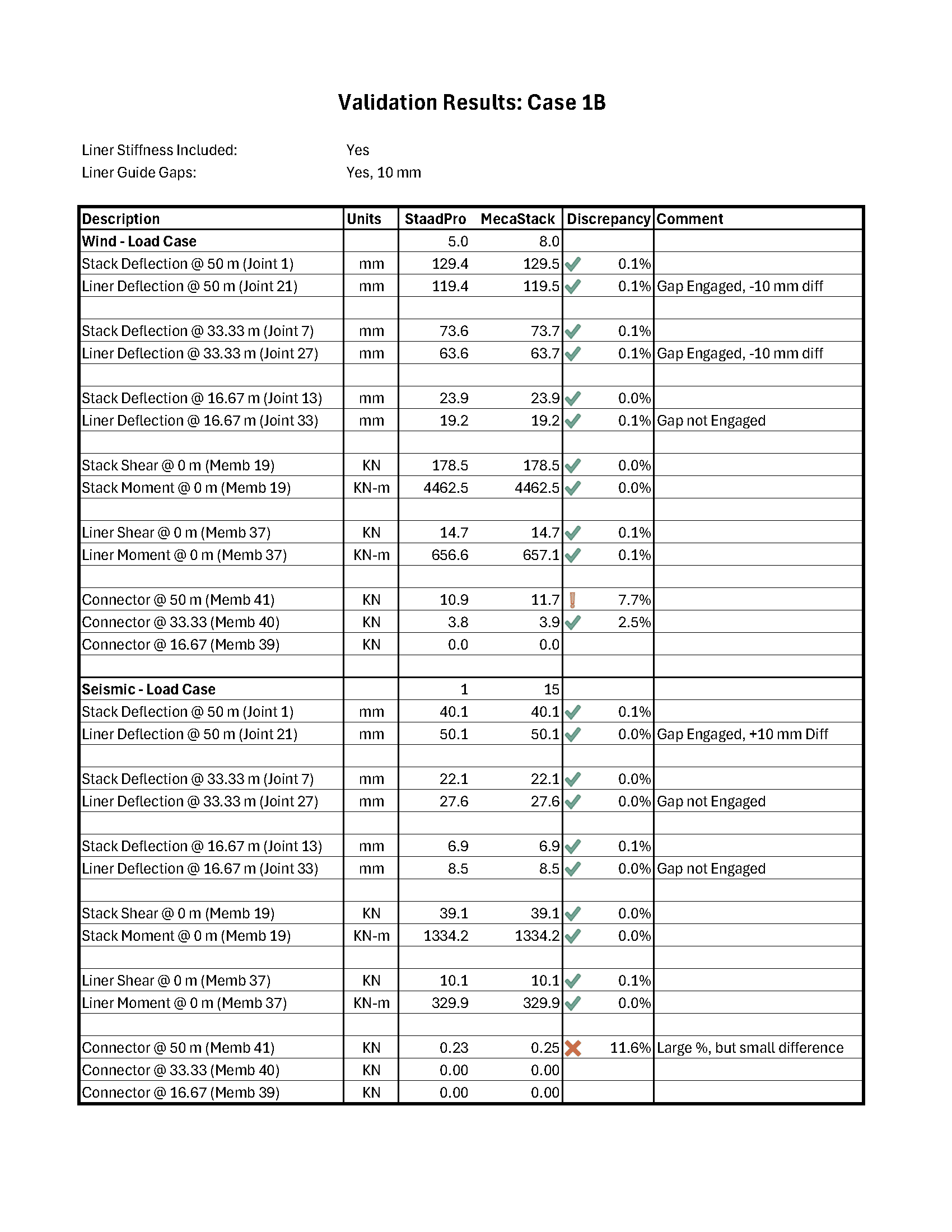
The effect that the gap has on the deflection values is worth noting. In this example the wind and seismic load behave differently. When wind is experienced, the stack will deflection 10 mm (Gap size) more than the liner, because the gap must be closed before the stack starts imposing lateral force on the liner through the connectors. The seismic load behaves differently, because the liner can be excited on its own. In this example the liner is deflecting more than the stack and so its displacements are 10 mm (Gap Size) more than the stack.

Case 2a: Liner Stiffness NOT Included
Some codes, such as ASME STS-1, indicate that the outer shell must be designed to withstand the lateral loads without any help considered from the liner.
MecaStack Approach to eliminate Liner Stiffness:
In order to accomplish this there are multiple analyses that must be performed:
Analysis 1 – Determine Liner Tributary Weights
The liner stiffness is to be ignored, but we still need to account for it’s weight in the seismic analysis. We need to determine a set of equivalent loads that will be applied to the stack which represents the weight of the liner. To do this we construct a structural model of just the liner and we apply all seismic active weight in the lateral direction. Lateral guide supports are assumed at each location where we have a connector between the outer riser and liner. Performing an analysis, we then get a lateral point load acting at each support. These point loads represent our liner tributary weights. These tributary weights will be added to the outer stack when performing the seismic analysis.

Analysis 2 – Determine outer Riser Deflections
This analysis will consider the wind and seismic loads acting on the stack. Wind loads are only on the outer riser (because the liner is not exposed to wind). The seismic loads consist of the seismic load on the outer stack, considering both the stack weight and the tributary liner weight. The lateral loads are applied to the stack and its deflected shape is determined. The results of this analysis are included in the comparison table for case 2a. The stack deflections and stack reactions are taken from this analysis.
Analysis 3 – Liner analysis
Now we have a complete analysis for the outer riser, we know displacements, stress, member forces and reactions. We did not account for any stiffness of the liner in that analysis, only it’s mass. Since our connectors between the outer riser and liner have no gaps, the liner is going to be forced to deflected the same amount as the outer riser at those points where the two are connected. We must analyze the liner for these imposed displacements, as well as any other loads that are acting locally on the liner.
There is no wind load on the liner directly, because it is not exposed to wind. We do have deflections of the outer stack for the wind case, and so we impose those displacements on the liner at the connector locations. We then determine the member end forces and reactions due to these imposed displacements.

There are some localized seismic loads acting on the liner because seismic is mass driven. Overall we did account for the liner mass in the seismic analysis of the outer riser; however, we do need to account for the seismic loads on the liner itself. We apply the liner seismic loads on the liner, in addition to the displacements that are imposed on it due to the displacements of the outer riser. The resulting member end forces and reactions can then be determined on the liner.
The liner results are also shown in the comparison table for our example. This model is used to create the values for the liner deflections and reactions. In the comparison of Staad.Pro and MecaStack the results agree very well, with one exception. The connector at 16.667 m has forces in the seismic load case with a discrepancy that exceeds our target percentage; however, the magnitude of the force is relatively small, and the difference is not significant numerically. All other results have good correlation.

Case 2b: Liner Stiffness NOT Included with Liner Gaps
This case is identical to Case 2a, except that our liner guides will be considered to each have 10 mm gaps. We performed the same type of analysis that was performed for 2a; however, the 10 mm gap is considered when imposing the displacements from the stack onto the liner. The addition of the gaps introduces quite a bit of complexity. The gaps are considered as follows:
- Outer stack deflections determined, just as in 2a
- Liner is analyzed by removing all guides, and the deflections determined
- Compare stack and Liner deflection and determine which guides will become engaged.
- Starting with the first guide that would become engaged, that restraint is added to the liner model.
- The liner deflections are then re-calculated based upon the addition of this new restraint.
- Determine if there are more guides that become engaged, and if there are then identify the next guide that will become engaged. Repeat from step 4 and 5 until there are no remaining guides to be engaged.
This is already complicated and It’s further complicated if we consider the time dependency. For example, if we are considering a seismic load then we are analyzing it with static loads but in reality, the stack and liner could be moving out of phase with each other. For example, the riser could be moving in one direction while the liner moving in the completely opposite direction. These considerations could significantly complicate the entire analysis. We reasoned that when the stack and liner are moving out of phase, there would be impact damping and the overall movement wouldn’t be able to reach the maximum displacements calculated. Moving in-phase might give the worst stress for the riser, and out-of-phase might give the worst load for the connectors. This all became too complicated, and we felt it was unnecessary. MecaStack assumes that the movements for the stack and liner are in phase with each other, this should give the worst case for the liner stress which we believe meets the intent of the standards.
In the comparison table below the results from MecaStack correlated very well to those from the Staad.Pro analysis. Please note that the seismic connector forces were all zero for the guides. This is because the relative displacements between the stack and liner were all less than the 10 mm gap, and so none of the gaps were engaged.

Compare Cases:
The results of MecaStack have been validated and in the process of we presented 4 different ways that the dual-wall stack can be analyzed. A summary of the results from each case can be found in the table below. There are some observations that can be made from this comparison:
- Deflections are higher when we ignore the stiffness of the liner in the overall analysis.
- Stack base reactions are the same for all cases
- Liner reactions at the base decrease when gaps are present, which would lead to lower liner stresses as well. This makes sense because it’s controlled by wind, and in the wind loading the stack will deflect 10 mm (size of gap) more than the liner.
- The connector forces can vary greatly from case to case. Our opinion is that the connector forces would be most accurate in Case 1’s, because that includes the stiffness of the stack and liner together which is the most realistic.

Conclusion
After writing this article I gained a whole new appreciation for designing a dual-wall stack, it’s a lot of work and can get very complicated. This article explains the analysis methodology for each Case and presents validation of the results using the commercially proven structural analysis software, Staad.Pro. Now the million-dollar question is when designing a dual-wall stack do you include the stiffness of the liner? My opinion is that if the design standard you are following indicates that the liner should not be considered when designing the outer stack, then I think you have little choice but to follow that direction and ignore the stiffness; however, I think the inclusion of the liner is the more realistic approach and I would also check the system with the stiffness included as well in order to ensure the worst case has been determined. Fortunately, with MecaStack that is a much simpler process to turn on or off the stiffness with the click of a button. In either scenario, if you have guides with gaps then I think that you should consider those gaps since it can change the results significantly. In the example we considered wind controlled, and the gaps reduced the loads on the liner; however, if seismic would have controlled then it’s possible that the gaps could have increased the loads on the liner.
MecaStack has the ability to model a dual wall stack and you can watch this video for more details on how that is accomplished using the software.